


Custom OEM gray iron castings manufactured from customer drawings, CAD files, samples, or technical specifications.
Material: Gray Iron / Cast Iron
Process: Sand Casting & Custom Casting
Machining: CNC Milling, Turning, Drilling & Boring
Applications: Machinery, Automotive, Agriculture, Pumps & Valves
Production: Prototype to Mass Production
Inspection: Dimensional & Material Testing
OEM / ODM Available
Send Your Drawing for a Quote →
Category: Clay Sand Casting
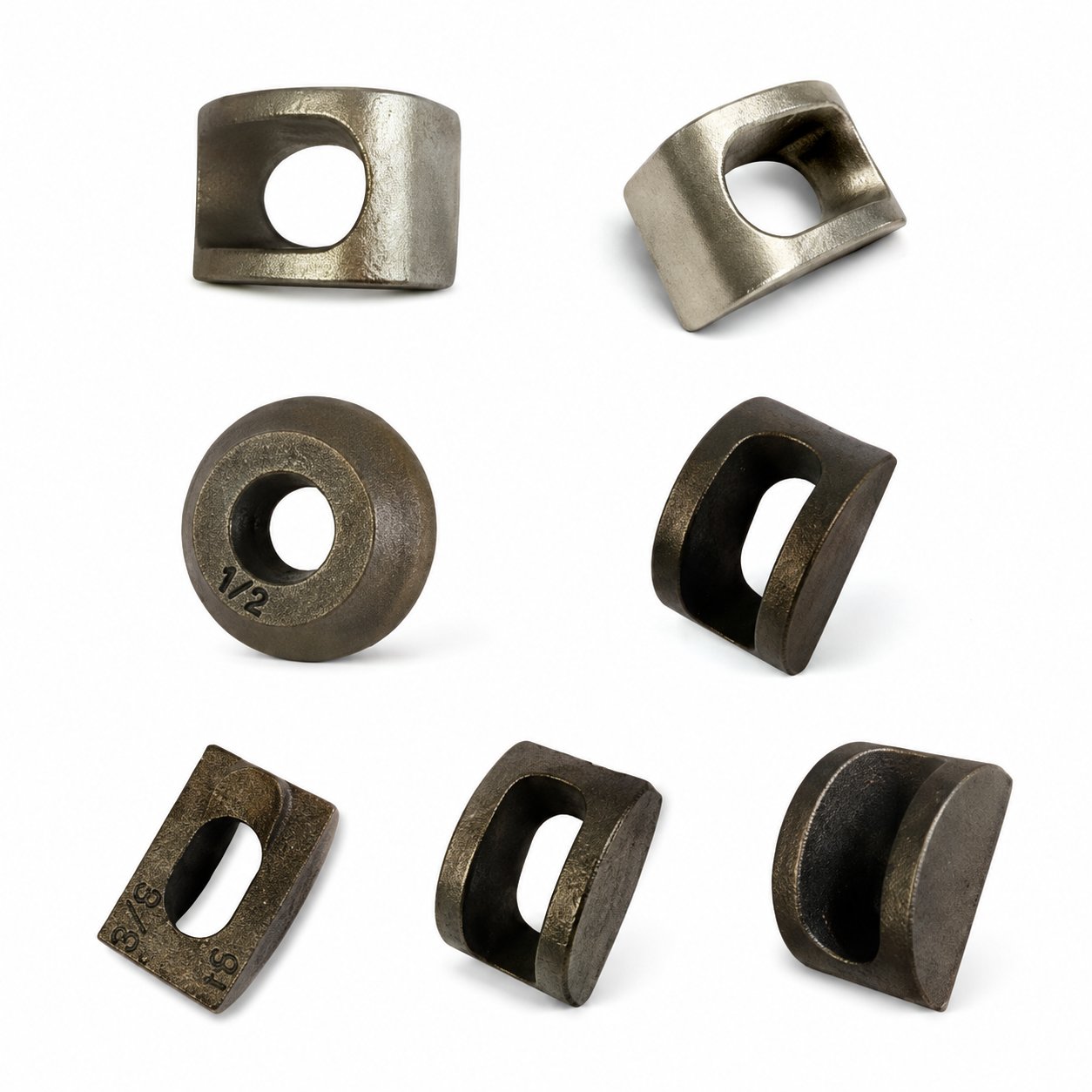 Qingdao Zhaoyuqi Machinery Co., Ltd. manufactures custom gray iron castings for OEM equipment manufacturers, machinery companies, and industrial component buyers. We produce cast iron parts according to customer drawings, 3D models, samples, or technical specifications, with support for casting, machining, surface finishing, inspection, and export packaging.
The gray iron casting components shown on this page represent the type of customized parts we can manufacture, including brackets, mounting components, support blocks, housings, connectors, and other mechanical parts with holes, slots, ribs, bosses, and irregular geometries.
Gray iron is particularly useful when a component requires good vibration damping, compressive strength, machinability, dimensional stability, and cost-effective production. For machinery and industrial equipment, these properties can make gray iron a practical alternative to fabricated steel or other materials when the component design is suitable for casting.
Our engineering team can review your part geometry before production and help determine the appropriate casting method, material grade, machining requirements, and inspection requirements for your application.
Custom gray iron castings manufactured according to customer drawings, material specifications, and machining requirements.
Gray iron castings are metal components produced by pouring molten gray cast iron into a mold that reproduces the required component geometry. The graphite in gray iron normally appears in flake form, giving the material its characteristic gray fracture surface and contributing to its excellent vibration-damping and machining characteristics.
Gray iron is widely used for components that experience vibration, compression, moderate wear, or repeated mechanical loading but do not require the higher tensile and impact performance of ductile iron.
Typical gray iron casting applications include:
Machine bases and frames
Gearbox and transmission housings
Pump and valve bodies
Motor housings
Brake components
Mounting brackets
Structural supports
Agricultural machinery components
Automotive components
Industrial equipment parts
The correct material grade should always be selected according to the actual load, temperature, wear, pressure, machining, and operating environment of the component.
Our production capability is suitable for a wide range of custom gray iron components.
We manufacture cast iron mounting blocks, brackets, support structures, base components, and mechanical connectors with machined mounting holes and contact surfaces.
These parts are commonly used to connect or support mechanical assemblies where dimensional stability and vibration damping are important.
Gray iron can be used for gearbox housings, motor housings, pump bodies, bearing housings, and other protective or structural enclosures.
Complex external geometries can be produced through casting, while critical mating surfaces and holes can be finished through machining.
Custom brackets and connectors can be manufactured according to customer drawings. Features such as mounting holes, slots, ribs, bosses, and curved surfaces can be incorporated into the casting design.
We also support custom gray iron parts for agricultural machinery, construction equipment, industrial machinery, pumps, valves, and other mechanical systems.
If you have a component that is currently manufactured by welding, fabrication, or machining from solid material, our engineers can evaluate whether converting it to a casting could simplify production or reduce machining requirements.
The right material depends on the actual application. Gray iron is not simply selected because it is inexpensive; its material characteristics can provide practical engineering advantages in specific applications.
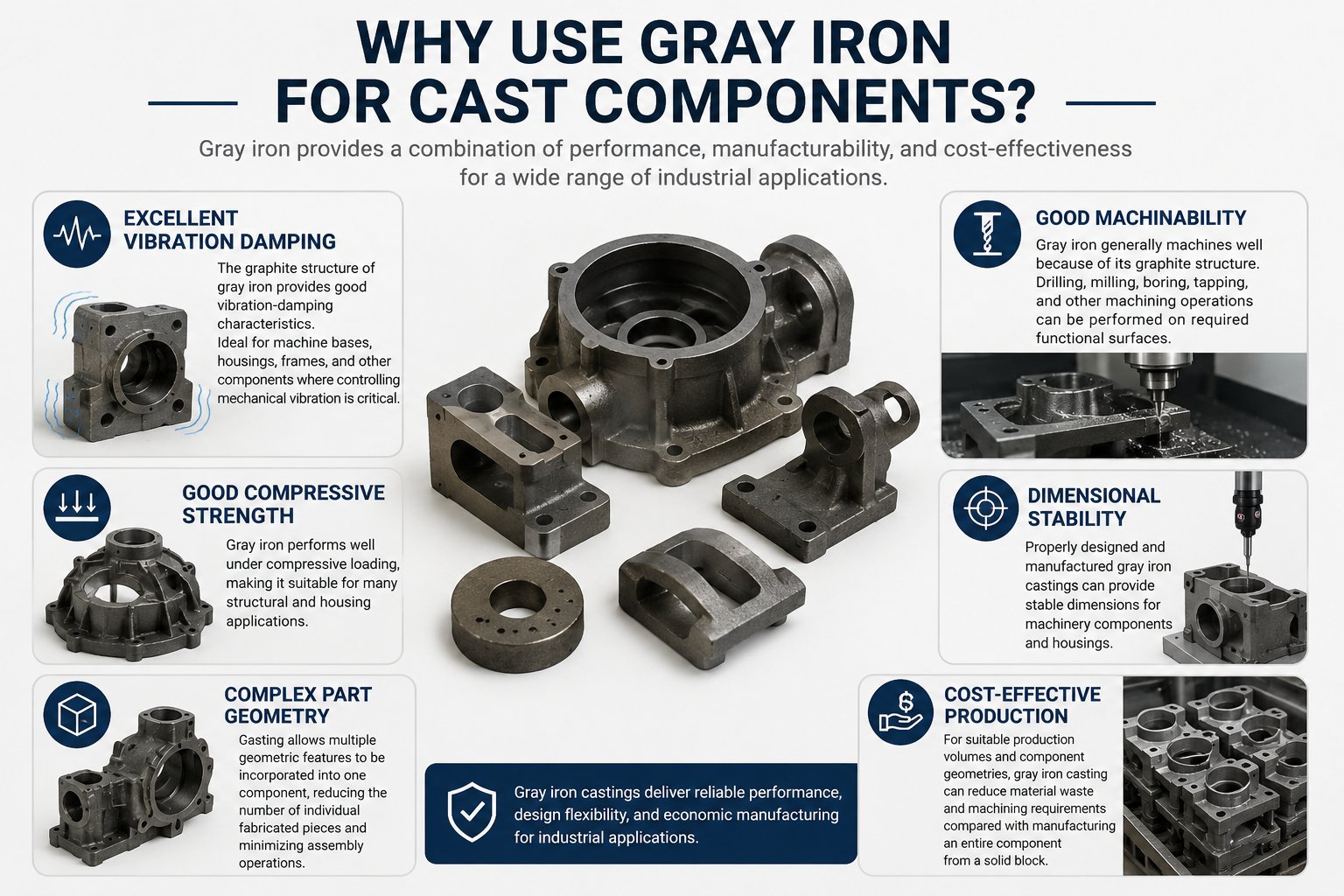
The graphite structure of gray iron provides good vibration-damping characteristics. This makes gray iron useful for machine bases, housings, frames, and other components where controlling mechanical vibration is important.
Gray iron generally machines well because of its graphite structure. Drilling, milling, boring, tapping, and other machining operations can be performed on required functional surfaces.
Gray iron performs well under compressive loading, making it suitable for many structural and housing applications.
Properly designed and manufactured gray iron castings can provide stable dimensions for machinery components and housings.
Casting allows multiple geometric features to be incorporated into one component. This can reduce the number of individual fabricated pieces and minimize assembly operations.
For suitable production volumes and component geometries, gray iron casting can reduce material waste and machining requirements compared with manufacturing an entire component from a solid block.
We can manufacture gray iron castings according to customer-specified material standards and drawings.
Common international gray iron standards include:
| Standard | Typical Material Designation |
|---|---|
| ASTM | ASTM A48 |
| EN | EN-GJL series |
| DIN | GG series |
| ISO | Applicable ISO gray iron grades |
| GB | HT series |
The exact grade should be confirmed before production because mechanical requirements vary between applications.
For OEM projects, customers can provide the required material grade directly. If you are unsure which gray iron grade is appropriate, provide us with the following information:
Part application
Maximum operating load
Working temperature
Required hardness
Wear conditions
Machining requirements
Applicable industry standard
Our engineering team can then evaluate the material requirements with you before quotation.
A reliable gray iron casting begins before molten metal enters the mold. Casting design, material selection, mold design, pouring conditions, cooling, cleaning, and machining all influence the final component.
We review your 2D drawings, 3D models, samples, dimensions, tolerances, and material requirements.
For complex parts, we evaluate wall thickness, machining allowances, draft angles, cores, ribs, holes, and other casting-related features.
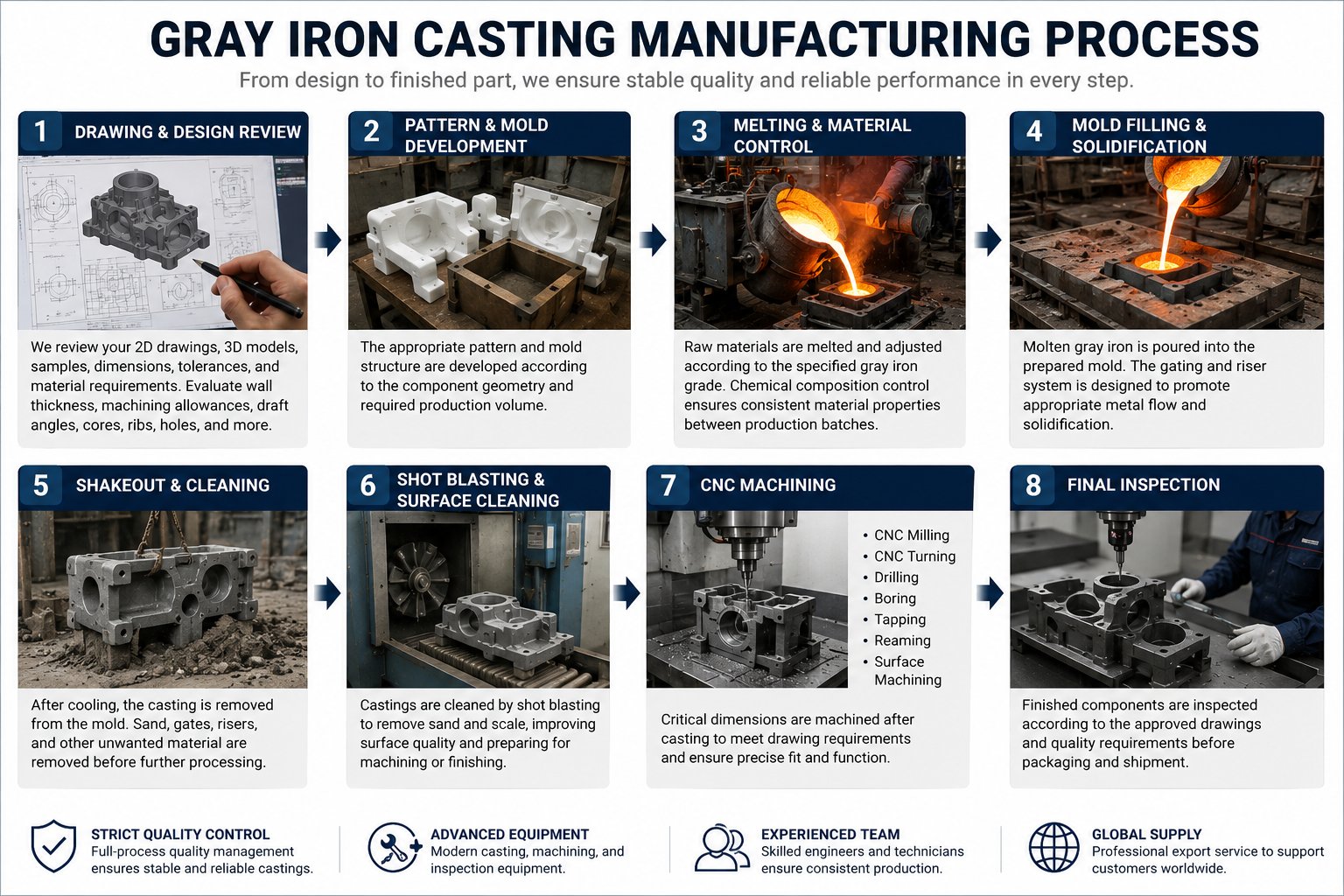
The appropriate pattern and mold structure are developed according to the component geometry and required production volume.
The raw materials are melted and adjusted according to the specified gray iron grade. Chemical composition control is important for maintaining consistent material properties between production batches.
Molten gray iron is poured into the prepared mold. The gating and riser system is designed to promote appropriate metal flow and solidification.
After cooling, the casting is removed from the mold. Sand, gates, risers, and other unwanted material are removed before further processing.
Castings can be cleaned and surface-finished according to the customer's requirements.
Critical dimensions can be machined after casting. Available operations may include:
CNC milling
CNC turning
Drilling
Boring
Tapping
Reaming
Surface machining
Finished components are inspected according to the approved drawings and quality requirements before packaging.
Our custom gray iron castings can be used across multiple industries.
Machine frames, housings, brackets, bases, covers, supports, and mechanical components.
Pump bodies, valve bodies, housings, covers, and other cast components where gray iron is suitable for the operating environment.
Engine-related components, brackets, housings, brake-related components, and structural parts depending on the customer's engineering specifications.
Gearbox housings, brackets, supports, covers, and other components used in tractors and agricultural equipment.
Custom housings, mounting components, brackets, and structural castings for machinery and equipment.
Customized gray iron parts for motors, transmissions, mechanical assemblies, industrial systems, and equipment manufacturers.
Casting and machining should not always be treated as separate purchasing processes.
For many OEM components, the casting provides the basic geometry while CNC machining creates the precise functional surfaces.
We can support machining requirements such as:
Mounting holes
Threaded holes
Bearing bores
Flat mounting surfaces
Shaft bores
Slots
Counterbores
Critical dimensional features
When requesting a quotation, providing the machining dimensions and tolerances on the drawing helps our engineering team evaluate the complete manufacturing process more accurately.
We manufacture gray iron casting parts according to customer-specific requirements rather than selling a fixed range of standard components.
You can send us:
2D engineering drawings
3D CAD files
Existing samples
Technical specifications
Material requirements
Annual demand
Prototype requirements
Our OEM workflow includes:
Drawing Review → Casting Evaluation → Quotation → Pattern/Tooling → Sample → Inspection → Mass Production → Machining → Final Inspection → Packaging
For existing parts, we can also evaluate whether the current manufacturing method can be optimized through casting.
For example, if a component is currently produced from a large machined steel block, the casting route may allow the near-net-shape geometry to be produced first, reducing the amount of material that must be removed during machining.
The feasibility depends on the actual geometry, quantity, material requirements, tolerances, and production conditions.
Casting quality should be controlled throughout production rather than relying only on final inspection.
Our quality control process can include:
Raw materials are checked according to applicable material and production requirements.
Chemical analysis can be performed to verify the material composition required for the specified grade.
Castings are visually inspected for surface defects, dimensional issues, and other visible abnormalities.
Critical dimensions are checked against customer drawings and agreed tolerances.
When required, mechanical properties such as hardness and tensile strength can be tested according to the applicable standard.
Machined surfaces, holes, threads, bores, and critical dimensions are inspected before shipment.
Material certificates and inspection documentation can be provided according to project requirements.
To provide a more accurate quotation and production assessment, please send as much of the following information as available:
1. Part drawing or 3D model
PDF, DWG, DXF, STEP, STP, IGES, or other commonly used engineering formats.
2. Material requirement
For example, ASTM A48, EN-GJL, DIN GG, GB HT, or your specified equivalent.
3. Annual or estimated quantity
Production volume affects tooling and manufacturing cost.
4. Machining requirements
Please identify critical dimensions, tolerances, threads, bores, and machined surfaces.
5. Surface treatment
For example, shot blasting, painting, coating, or other specified finishing.
6. Inspection requirements
Please specify any dimensional reports, material certificates, mechanical testing, or other documentation required.
The more complete the technical information, the more accurately our engineers can evaluate the project.
Gray iron casting is commonly used for machine bases, housings, brackets, pump bodies, valve components, agricultural machinery parts, automotive components, and other mechanical applications where vibration damping, machinability, and compressive strength are important.
Gray iron contains graphite primarily in flake form, while ductile iron contains graphite in nodular form. Gray iron generally offers better vibration damping and machinability, while ductile iron typically provides higher tensile strength and impact resistance. The appropriate material depends on the application.
Yes. We provide custom OEM manufacturing based on customer drawings, CAD files, samples, and technical specifications.
Yes. CNC milling, drilling, boring, tapping, turning, and other machining operations can be provided according to the component design.
Depending on the project, gray iron castings can be produced according to standards such as ASTM, EN, DIN, ISO, and GB. The exact grade should be confirmed before production.
Prototype and sample production can be discussed according to component geometry, tooling requirements, and project volume.
A drawing or 3D model, material requirement, estimated quantity, machining requirements, surface treatment, and inspection requirements are the most useful information for quotation and engineering evaluation.
Yes. Inspection and material documentation can be provided according to the agreed project requirements.
Looking for a custom gray iron casting manufacturer in China?
Send us your drawing, 3D model, sample information, or technical requirements. Our engineering team can evaluate the casting structure, material requirements, machining needs, and production process before providing a quotation.
Whether you need a prototype, replacement component, or long-term OEM supply, Qingdao Zhaoyuqi Machinery Co., Ltd. can support your project from casting development to machining and final delivery.
Send Your Drawing → Technical Review → Quotation → Sample Approval → Production
Contact us to discuss your next gray iron casting project.

Professional technical research and development team to provide customers with the best solution.
Jimo District, Qingdao City, Shandong Province, China
© 2024 Qingdao Zhaoyuqi Machinery Co., Ltd. Powered by HiCheng
 Sitemap
|
Privacy Policy
Sitemap
|
Privacy Policy
